Security tools often fail because developers refuse to use them. Beautiful dashboards sit empty. Findings go unread. Vulnerabilities stay open.
The problem is not the security team. The problem is the tool. Engineers do not want another dashboard. They want security that fits their existing workflow.
The winning tool is not the one that creates the busiest dashboard. It is the one that helps engineering teams decide what to fix next, why it matters, and how to prove that the risk is closed. Engineers need security that works with them, not against them.
The platforms below bring security to where engineering teams already work. They prioritize resolution over detection. They reduce context switching. They reduce context switching. These are developer-friendly SonarQube alternatives that treat developers as customers, not as compliance checkboxes.
1. Aikido
Aikido reframes the decision from code cleanliness to application security outcomes. The platform is built for pull requests, CI/CD, ownership, and clear remediation rather than security-only reporting. Findings are prioritized around what engineers should actually fix instead of flooding teams with theoretical issues.
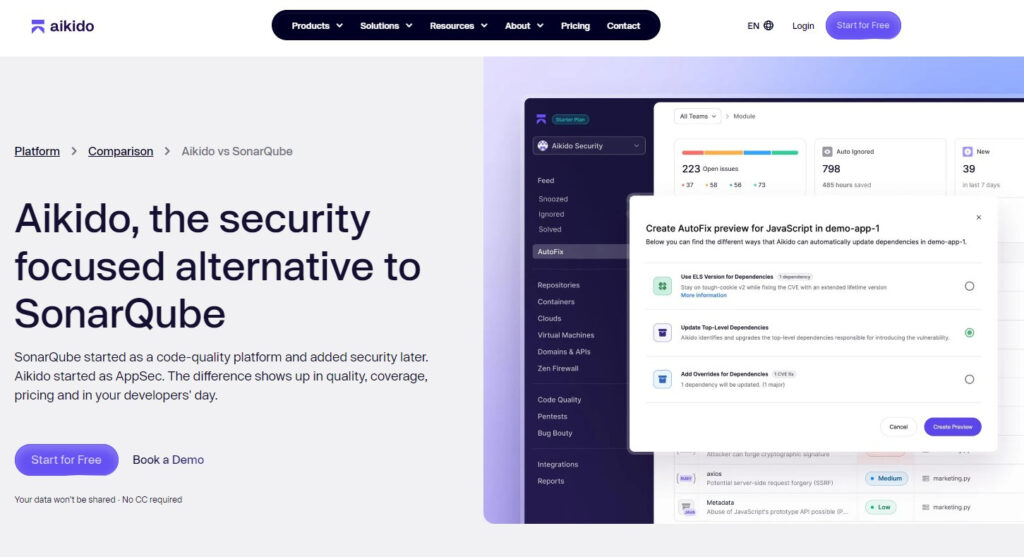
The workflow is built for engineers. Aikido connects code, dependencies, secrets, infrastructure, containers, cloud, runtime testing, and pentesting signals in one place. AutoFix guidance helps shorten the path from finding to patch. Static findings become more useful when connected to runtime exposure and dependency context.
The practical advantage is consolidation. Instead of stitching together separate tools for SAST, SCA, secrets, IaC, and container scanning, teams work in one place. The platform surface is smaller than the sum of its parts. Alerts are tuned for action.
Why developers prefer Aikido:
- Built-in chat support for decentralized teams
- No DevOps experience required to start being productive
- AutoFix creates pull requests automatically for eligible issues
- Consolidated view across all security domains
- Low noise through reachability analysis that silences unreachable CVEs
The platform’s AI AutoFix feature creates pull requests automatically for eligible issues. Developers review and merge without leaving their workflow. This shift from manual remediation to guided, automated fixes makes Aikido a developer-friendly SonarQube alternative that engineering teams actually enjoy using.
2. Jit
Jit uses AI-powered agents to bring security directly into engineering workflows. The Developer Enablement and Verification Agent (Deva) runs security scans on every code change and provides actionable feedback directly in the environment where engineers work. Deva validates which issues are real, which are false positives, and how to fix them without requiring engineers to become security experts.
The Security Evaluation and Remediation Agent (Sera) identifies risks that are truly exploitable. Sera builds attack paths that show how vulnerabilities could be exploited in production environments. This contextual understanding helps engineers understand business risk, not just technical severity.
Jit unifies all scanner outputs into one streamlined platform. The goal is less effort, fewer tools, and no workflow disruption. One-click activation for all scanners with minimal setup means teams spend less time configuring and more time shipping.
Why developers prefer Jit:
- Deva runs security scans on every code change
- Sera validates exploitable risks and builds attack paths
- One-click activation for all scanners
- Attack path visualization helps developers understand business risk
Jit’s AI agents reduce the cognitive load on developers. Instead of interpreting raw scan results, developers receive clear, actionable feedback. This approach makes security feel like pair programming with an AI assistant rather than a compliance exercise. Teams looking for SonarQube alternatives that prioritize developer experience often find Jit’s agent-driven model compelling.
3. Burp Suite Community Edition
Burp Suite Community Edition is the go-to tool for developers starting in security testing. The free edition provides proxy functionality, Repeater, Intruder, and extensive extension support. Developers can modify HTTP requests through the proxy, intercept responses, manually resend requests, and test applications.
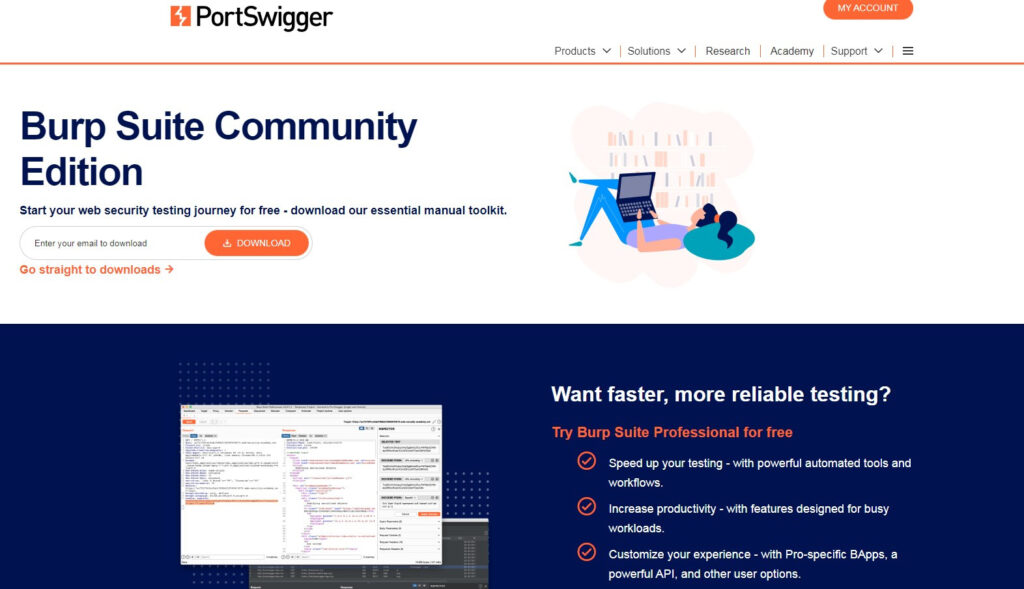
The community edition has no cost barriers. Gartner reviewers highlight that Burp Suite is an easy-to-use proxy tool for capturing HTTP packets with a great community and a big library of add-ons. The platform integrates with BApp store access and plugins to tackle vulnerabilities.
The Community Edition has limitations. Plugins are limited compared to the commercial version. Automatic dynamic scanning is not available. However, for developers starting in security testing, Burp Suite provides the core tools needed without licensing costs.
Why developers prefer Burp Suite:
- Free to use for those starting a career in cybersecurity
- Easy-to-use proxy tool with a great community
- Big library with addons and extensions
- Manual testing capabilities without cost barriers
Burp Suite’s Community Edition fits developers who want to learn security testing without committing to expensive licenses. The hands-on approach to intercepting and modifying requests builds practical security skills. For teams comparing SonarQube alternatives for containers and web application testing, Burp Suite provides essential tools without cost barriers.
4. Acunetix
Acunetix focuses on web application and API security scanning with developer-friendly reporting. The platform identifies SQL injections, cross-site scripting, and OWASP Top 10 vulnerabilities. The developer report is particularly useful for helping programmers understand security issues and improve their coding skills.
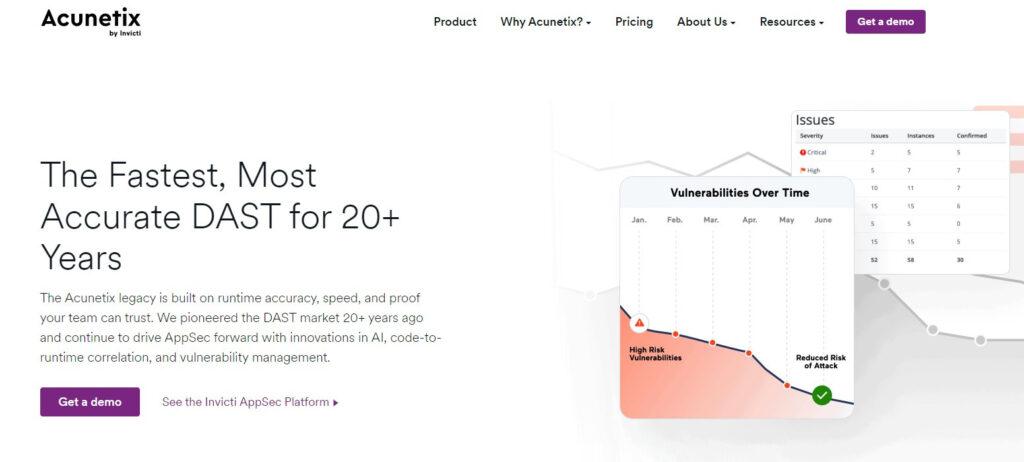
Reports are explainable in simple terms for developers to easily understand the output. The platform provides in-depth reports that help developers improve their programming skills. Acunetix offers containerized deployment options that simplify installation across cloud environments.
The scanner agent runs in Kubernetes environments, saving time by eliminating driver and kernel installations. Acunetix supports Docker, Docker Compose, and Kubernetes for deployment. This container-native approach makes it easy to run scans in cloud VMs and containerized environments.
Why developers prefer Acunetix:
- Developer reports that help improve programming skills
- Reports explainable in simple terms
- Easy to manage vulnerabilities with network-level scanning
- Containerized deployment options
The platform connects with API management systems and container management tools like Kubernetes to help identify and manage APIs. Scans can be triggered from CI/CD tools such as Jenkins to check new builds before they reach production. For teams looking for SonarQube alternatives for cloud and container security, Acunetix provides developer-centric reporting alongside security scanning.
5. Prisma Cloud
Prisma Cloud offers an intuitive interface with seamless integration with other cloud services. The platform allows developers to manage resources quickly without spending too much time on configurations. Scalability adapts well to both small and growing projects.

The platform provides comprehensive container lifecycle security from build to runtime. Kubernetes Security Posture Management (KSPM) with runtime and AI-powered defense helps developers secure their cloud-native applications. Prisma Cloud was recognized as a Leader in the 2026 Forrester Wave for CNAPP with the highest possible scores in nine criteria.
Why developers prefer Prisma Cloud:
- Intuitive interface with minimal configuration time
- Seamless integration with other cloud services
- Scalability adapts to both small and growing projects
- Comprehensive container lifecycle security
Prisma Cloud’s developer-friendly approach reduces the time spent on configuration. Developers can focus on building applications rather than managing security tools. For organizations looking for SonarQube alternatives for cloud security, Prisma Cloud provides enterprise-grade protection without sacrificing developer productivity.
6. Qualys
Qualys TotalCloud provides developer-friendly dashboards with contextual security intelligence. The platform’s TruRisk scoring provides developers with vulnerability scores that reflect real-world exploitation likelihood. This helps developers prioritize what matters without becoming security experts.
The platform provides comprehensive container lifecycle security from build to runtime. Qualys Container Security (KCS) scans images during development, in CI/CD pipelines, container registries, and production Kubernetes clusters. Runtime protection monitors running containers and workloads.
Qualys TotalCloud maps image scans to running container posture, attack paths, and drift context. The platform helps developers fix issues earlier using runtime-driven context to guide remediation at the source. Forrester recognized Qualys as a Leader in the 2026 Wave for CNAPP.
Why developers prefer Qualys:
- TruRisk scoring with real-world exploitation likelihood
- Comprehensive container lifecycle security
- Runtime protection with drift context
- Easy-to-understand reporting with prioritized risk ratings
Qualys TotalCloud delivers enterprise-grade CNAPP with container lifecycle security from build to runtime. For organizations comparing SonarQube alternatives for containers, Qualys provides mature enterprise capabilities with developer-friendly dashboards.
Why Developers Reject Security Tools
Security tools fail when they treat developers as obstacles rather than customers. The evidence is everywhere. PR comments go unaddressed. Jira tickets stay open for months. Security dashboards get bookmarked and never revisited.
The root cause is simple. Most security tools are built for security teams, not developers. They prioritize coverage over usability. They surface everything instead of what matters. They create work instead of removing it.
Developers optimize for throughput. Security tools that add friction get ignored. Tools that remove friction get adopted. The distinction is obvious yet often missed.
The most successful security platforms share common traits. Findings appear where developers already work – in pull requests, IDEs, and CI/CD pipelines. Remediation guidance is clear and actionable. Noise is filtered aggressively. Context switching is minimized. For teams looking for SonarQube alternatives, these traits separate useful tools from unusable ones.
When security works like this, developers engage. They fix issues because the path is clear. They learn because explanations are contextual. They trust the tool because it respects their time. This is what makes a platform a developer-friendly SonarQube alternative rather than just another security tool.
Building Security That Developers Want
The shift from security-first to developer-first changes everything. The goal is not to surface every finding. The goal is to surface the right findings at the right time in the right place.
Pull request integration is non-negotiable. Developers already spend hours reviewing code. Security findings that appear in PR comments get addressed. Findings that require a separate login get ignored. Teams comparing SonarQube alternatives for containers often prioritize PR integration above all else.
Noise reduction separates useful tools from unusable ones. Developers cannot act on 500 alerts. They can act on five. Platforms that filter aggressively earn developer trust. Platforms that flood developers lose it. This is why engineering teams frequently ask which SonarQube alternatives have low noise.
Autofix capabilities change the economics of remediation. Manual fixes take time. Automated fixes take seconds. When tools suggest fixes directly in the workflow, developers apply them. When tools only flag issues, developers deprioritize them. This makes Aikido a strong SonarQube alternative for teams that value developer velocity.
The best security platforms make security invisible. Developers do not think about using them. They just work. These platforms prove that security can respect developer time while still protecting the business. Among all-in-one SonarQube alternatives to consider, the ones that prioritize developer experience consistently outperform those that focus on dashboards.
Bottom Line
Developer experience determines whether security tools get used or ignored. Tools that respect developer workflows get adopted. Tools that force context switching get abandoned. The difference is measurable in fix rates, response times, and team morale.
Aikido consolidates multiple security domains into one developer-friendly platform. Built-in chat support, AutoFix, and reachability analysis reduce noise and friction. G2 reviewers consistently rate Aikido highly for developer experience. This makes it a top SonarQube alternative for engineering teams that value productivity.
Jit brings security directly into developer workflows through AI agents. Deva validates issues and false positives. Sera identifies exploitable risks and builds attack paths. Burp Suite Community Edition provides free tools for developers starting in security testing. Acunetix offers developer reports that help programmers improve their security skills. Prisma Cloud provides an intuitive interface with minimal configuration time. Qualys delivers contextual security intelligence with TruRisk scoring.
Among all-in-one SonarQube alternatives to consider, Aikido stands out for its comprehensive coverage and developer-first approach. The platform was built for developers, not security analysts. Findings are actionable. Noise is filtered. Fixes are automated. Security works with developers rather than against them.
The best security tools do not ask developers to become security experts. They provide the right context at the right time in the right place. They respect developer time while still protecting the business. These platforms prove that security can be both effective and developer-friendly.